Why Anti-Polishing Rings Matter
Heavy-duty engines run in high-soot, high-pressure environments that make carbon accumulation and bore polishing common problems. When carbon builds up at the top of the cylinder, it can smooth the liner’s surface and reduce its ability to hold oil. The loss of the crosshatch pattern leads to higher oil consumption, faster wear and reduced compression. Carbon can also trap the top ring in its groove, limiting its movement and hurting sealing performance.
Anti-polishing rings (APRs) are designed to prevent these issues before they start. Installed in a counterbore at the top of the liner, the APR lightly contacts the piston crown at top dead center, removing carbon before it can accumulate. By keeping the liner surface intact and the ring pack free to move, APRs help maintain consistent performance and protect critical components over long service intervals.

What an Anti-Polishing Ring Does
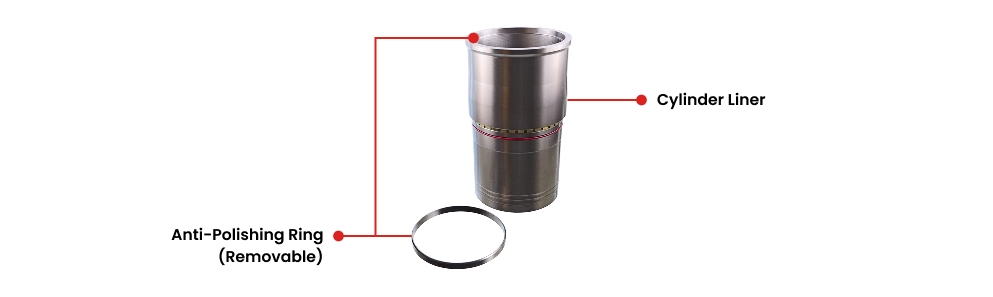
An anti-polishing ring is a fixed insert at the top of the cylinder liner. As the piston reaches top dead center, the APR makes light contact with the outer edge of the crown, shaving carbon from the top land before it can accumulate. This keeps carbon from building into thick deposits and breaks it into smaller particles that pass more easily through the engine’s EGR, turbo and aftertreatment systems.
Because the APR is stationary, it functions as a carbon-control point every time the piston reaches top dead center. This limits how much carbon reaches the top groove ring and helps prevent the ring from sticking in its land. By keeping the upper bore clean and protecting the liner’s crosshatch, the APR supports proper ring expansion and stable sealing performance.
APR-Compatible Components: Pistons and Sleeves
Engines designed for anti-polishing rings use pistons with a smaller crown diameter to ensure proper clearance as the crown passes through the APR at top dead center. These pistons also feature a lower top-ring position, giving the ring pack enough space to operate below the APR’s carbon-control zone. Both changes are intentional: they prevent contact with the APR and help the system manage carbon without interfering with ring movement.
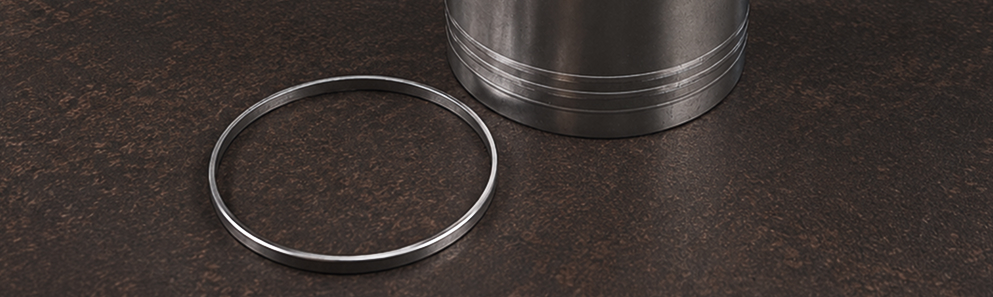
The cylinder sleeve also has a distinctive design. APR liners have a counterbore at the top that houses the ring, along with two bands or grooves visible from the underside. Unlike standard liners, APR sleeves have a flat top surface with the counterbore machined just below it. These features make it easy to confirm whether a liner is APR-equipped and ensure the correct piston and installation tools are used during assembly.
Installation Considerations and Best Practices
Anti-polishing rings are symmetrical, so there’s no top or bottom orientation to manage during assembly. The critical detail is ensuring the correct piston and liner pairing, since APR systems rely on the smaller crown diameter and lower top-ring position built into APR-compatible pistons. Mixing components can lead to interference at the counterbore or improper ring operation once the engine is running.
Loading the piston into an APR liner requires the right tooling. Because the liner has a machined counterbore for the APR, the ring compressor must use an APR-specific adaptor to guide the ring pack past the step and down to the sleeve wall without catching. Using the proper adaptor protects the rings, the liner and the APR itself, ensuring the assembly seats smoothly and the system performs as intended.
FP Diesel® APR Rings: Material Matching & OE-Level Fit
Sleeves used in APR applications can be manufactured from cast iron, ductile iron or steel, depending on the engine’s design and durability requirements. Because the APR sits in a machined counterbore at the top of the liner, the fit between the ring and sleeve must be exact. Any mismatch in material or machining can affect how the APR seats, how it handles heat and how consistently it removes carbon over time.
To maintain that precision, FP Diesel APRs and sleeves are made from the same material. This ensures the APR and the liner expand, contract and wear at the same rate, preserving the counterbore fit and meeting OE requirements. Matching materials also helps the APR maintain its shape and effectiveness over long service intervals, supporting reliable carbon control throughout the life of the sleeve.
Learn more about quality heavy-duty vehicle parts, find the right car part or find a local repair shop today.
The content in this article is for informational purposes only. You should consult with a certified technician or mechanic if you have questions relating to any of the topics covered herein. DRiV and its affiliates (including Federal-Mogul Motorparts LLC) will not be liable for any loss or damage caused by your reliance on any content.